Basic Authentication
The Basic Authentication method uses a username (Tenant ID) and password (API Key). This username and password will then need to be Base64 encoded to be used in the API call. This authorization method is best for backward compatibility with existing API integrations.
Note
If the API key was generated before October 2025, a new API key will need to be generated to make sure it is compatible with the new API gateway.
Users will need to generate an API key in PackNet before using the basic authentication method with the PackNet API Gateway.
Log in to PackNet Software Platform.
Go to Configuration > Settings > API.
Select Add API Connection.

Select API Key.
Enter a name for the API Key.
Select the API services the API key will be used for:
Migration
Import
Dim
Production
Cube
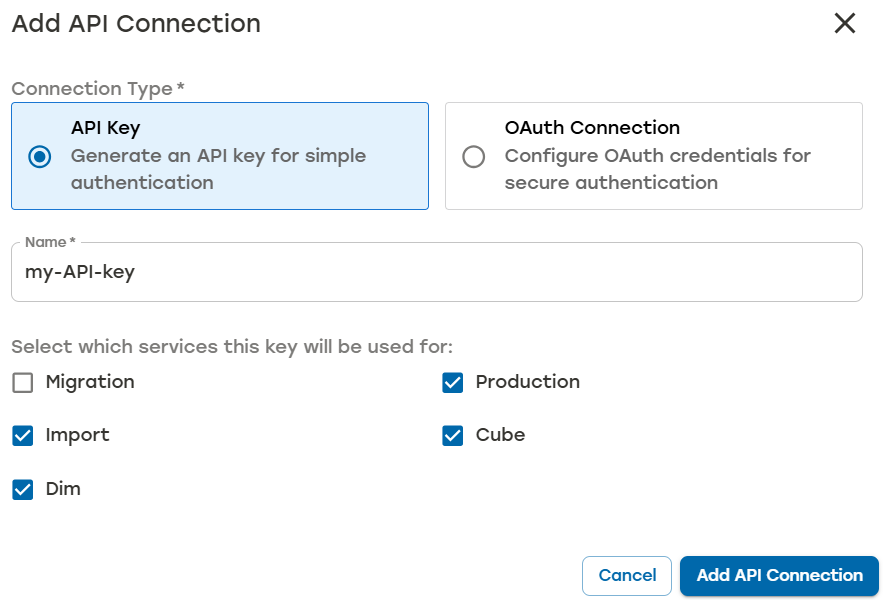
Select Add API Connection.
Copy the Tenant ID and API Key and store the API Key securely for future use.
Important
The API Key will only be displayed once and cannot be retrieved later. It should not be shared.
Once created, the API connection will be shown in the API list with the name and services specified, Connection Type = API Key, and created date.
API keys remain valid unless they are explicitly revoked by deleting them from PackNet. Multiple API keys can be generated as needed.
Copy Tenant ID
The Tenant ID can be copied at a later time if needed. The API Key will only be displayed once during API key creation.
Log in to PackNet Software Platform.
Go to Configuration > Settings > API.
Select Copy Tenant ID.

How to Use Basic Authentication
The Basic Authentication method uses a username (Tenant ID) and password (API Key). This username and password will then need to be Base64 encoded to be used in the API Authorization header.
Encode the credentials as tenantId:apiKey in Base64 format.
Base64 Example
Tenant ID:
550e8400-e29b-41d4-a716-446655440000API Key:
pk_live_abc123xyz789Combined:
550e8400-e29b-41d4-a716-446655440000:pk_live_abc123xyz789Base64:
NTUwZTg0MDAtZTI5Yi00MWQ0LWE3MTYtNDQ2NjU1NDQwMDAwOnBrX2xpdmVfYWJjMTIzeHl6Nzg5
CURL Samples
In the below CURL samples, BASE_64_ENCODED_CREDENTIALS are the tenantId:ApiKey encoded with base64
Windows PowerShell
Windows expects double quotes (" "). PowerShell uses backticks (`) for multiline commands.
curl --location "https://api.prod1.packnet.app/Dim/v1/Import" `
  --header "Authorization: Basic BASE_64_ENCODED_CREDENTIALS" `
  --header "Content-Type: application/json"
Windows CMD (Command Prompt) CURL Header Sample
Windows expects double quotes (" "). CMD doesn’t support multiline.
curl --location "https://api.prod1.packnet.app/Dim/v1/Import" --header "Authorization: Basic BASE_64_ENCODED_CREDENTIALS" --header "Content-Type: application/json"
Linux and MAC CURL Header Sample
Linux and MAC expect single quotes (' '). Use backslash (\) for multiline commands.
curl --location 'https://api.prod1.packnet.app/Dim/v1/Import' \
--header 'Authorization: Basic BASE_64_ENCODED_CREDENTIALS' \
--header 'Content-Type: application/json'
Important
Do not delete an API connection unless instructed to do so. Deleting an API connection from the tenant immediately revokes access for all applications using it and can negatively impact the way jobs are produced.
Go to Configuration > Settings > API and locate the API key.
Select the information icon next to the API key to be deleted.
Select Delete.
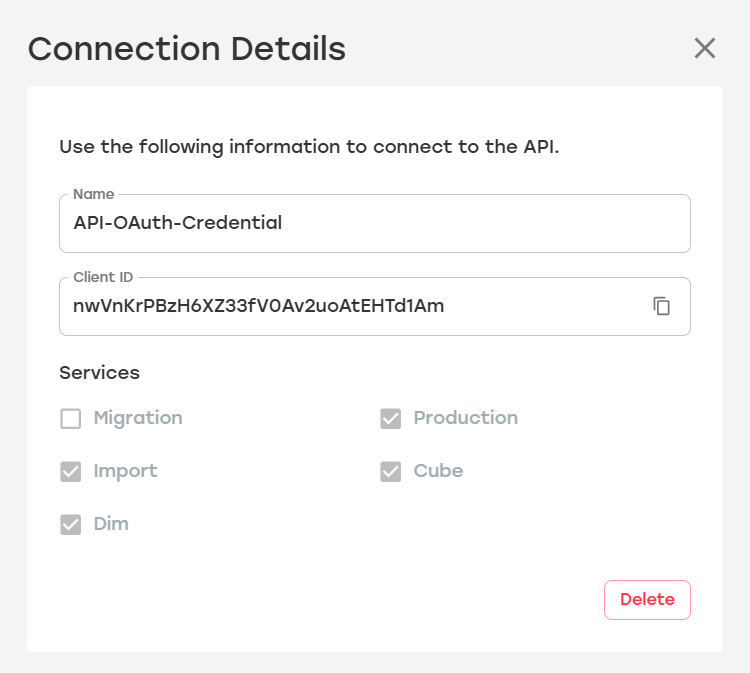
A dialog will appear asking to confirm deletion. Enter delete into the textbox, and then select Delete.
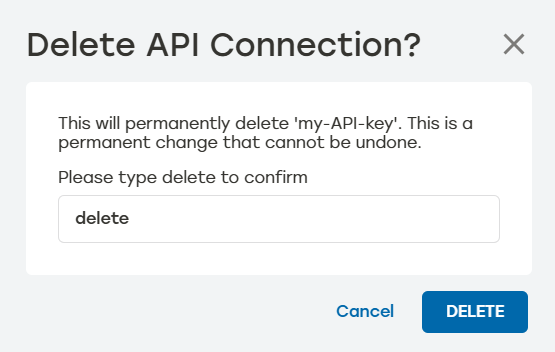
Confirm the API key deletion.